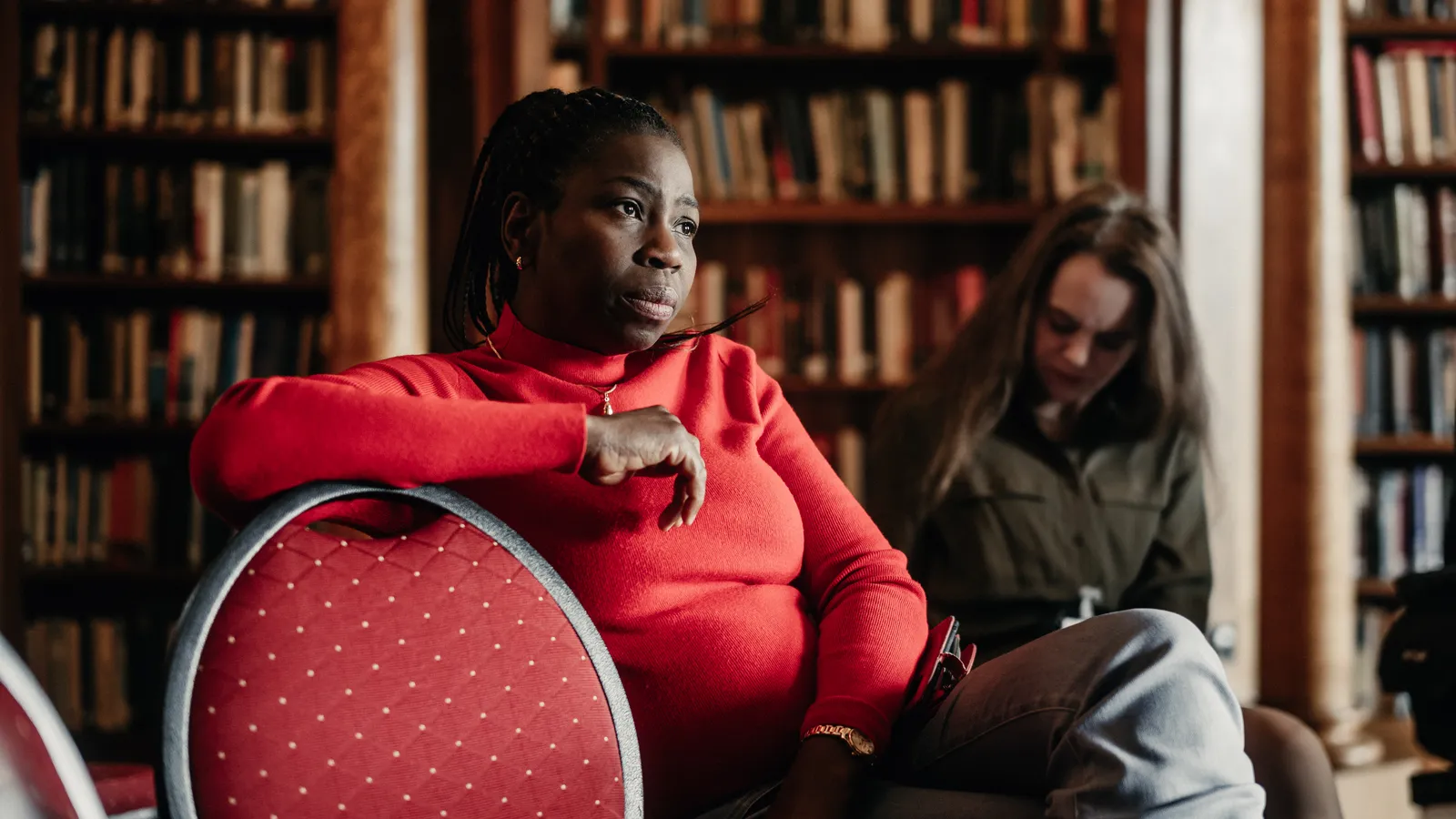
 Bola Owolabi at the Sciana residential meeting in Salzburg in May 2026. Photo Credit: Richard Schabetsberger
Designing care around communities for equitable outcomes
29 Jun 2026
by Areesha Rehan
Sciana Fellow Bola Owolabi on systems leadership, addressing health inequalities, and building alliances for an interconnected health ecosystem
Bola Owolabi is Chief Inspector of Primary Care and Community Services at the Care Quality Commission (CQC). Prior to that role, she was Director of the National Healthcare Inequalities Improvement Programme at NHS England. She's a Board member of Housing 21 (currently on Sabbatical), a leading, not for profit, national provider of Social Housing and an Honorary Professor at the School of Medicine and Dentistry, University of Birmingham. She’s a qualified General Practitioner. In addition to her roles in health policy, academia, and the not-for-profit sectors, Bola is Vice President of the Royal Society for Public Health, the oldest public health organisation established by Royal Statute in the UK. Bola has particular interests in reducing health inequalities through Integrated Care Models, Service Transformation, and using data and insights for quality improvement. She spearheaded NHS England's flagship Core20PLUS5 approach to narrowing health inequalities. She is an alumni of Ashridge Executive Education/Hult International Business School and holds a Master's degree with distinction in leadership (Quality Improvement) and holds an NHS Leadership Academy Award in Executive Healthcare Leadership for Clinicians. She is a member of Sciana’s seventh cohort.
This interview has been edited for brevity and clarity.
Sciana Network: How would you define systems leadership, and what does it mean to you?
Bola Owolabi: I think systems leadership recognises that to achieve large, impactful change, we have to partner with others. Many of the challenges that face society are complex, longstanding, and insoluble for individuals alone. For me, systems leadership is a form of leadership that is humble enough to recognise that, and seeks solutions through distributed leadership, building coalitions and partnerships, and understands that there are no straightforward, linear solutions.
SN: What sections of society are most underserved by the public health system in the UK, and what can be done to target them?
BO: We described the communities that tend to be underserved, marginalized, and seldom heard in the CORE20PLUS5 framework. We described them as the CORE20PLUS: That is the 20% most socioeconomically deprived based on the index of multiple deprivation, plus other communities such as some sections of ethnic minority communities, coastal communities, inclusion health populations such as people experiencing homelessness or rough sleeping, some of our traveller communities such as Gypsy, Roma, Traveler (GRT) communities, and some people living with learning disabilities and/or autism.
We identified this CORE20PLUS population group as being most underserved, and therefore requiring an intentional, focused approach to dealing with inequalities in access, experience, and outcomes from health and health care more generally. But more importantly, it's not just identifying these groups, it's what we actually do to address those inequalities that they're facing.
SN: What are some examples of addressing those health inequalities?
BO: Some of the things that we did in the CORE20PLUS5 approach was we recognised that premature mortality affects those communities more, and that premature mortality is driven by conditions such as late cancer diagnosis, differentials in maternal health outcomes, cardiovascular disease, severe mental ill health, and chronic respiratory disease. We used different levers to address those clinical conditions.
We built what we call the ‘CORE20PLUS ecosystem’, which included grassroots people, the CORE20PLUS connectors, who convened those communities to understand why, for example, the uptake of cancer screening programs was so low.
Once we understood why, it was about then putting in place things like outreach models. For example, with black men and prostate cancer, we started putting on prostate cancer awareness events in Domino's clubs, because we know that's where some black men will tend to congregate. We started checking people's blood pressure in village halls and training people to talk about mental health in barber shops, because people would rather do that than go and see a healthcare professional. To counter low vaccination uptake, we started providing the vaccines in places where people are more likely to go, such as places of worship, whether that's churches, or mosques, or temples.
We found that black women have worse maternal health outcomes, and sometimes it's because of the lack of awareness that if you already have high blood pressure and get pregnant, your outcomes are worse, [so we helped create] community groups where you can have a conversation with women about it and where they could go to get help.
We took innovative and creative ways to reach communities and redesign healthcare services around communities, rather than asking people to come and fit around our services. We talked about using innovative approaches, not just innovative products, so we used trusted voices, trusted people in communities, and redesigned services to fit around people in those communities. Outreach models of care are some of the ways that we turned the framework into meaningful action on the ground.
SN: Why is the Cohort 7 Sciana Challenge, ‘Systems leadership for population health in times of scarcity’, relevant right now?
BO: We're living through a time of significant geopolitical shifts that are driving people towards a narrative that says, ‘For me to be alright, others must be downtrodden’. We are seeing a shift from the collective good to the narrative of ‘I’. We are seeing a shift from seeing the world through the lens of an abundance mentality towards a scarcity mentality.
In the face of that, and the scarcity of resources, it is important to recognise that leaders are purveyors and sellers of hope. Anybody can talk about how terrible, awful, and dreadful things are; it takes leadership to be able to craft and share a message of hope, even in the middle of scarcity.
That doesn't mean that hope is irresponsible Pollyanna or unrealistic utopia. Hope is a powerful determination to focus on possibilities rather than eternally analysing problems. The way to make progress in times of scarcity is to:
- Reframe the narrative
- Speak the language of hope
- Find unusual alliances
[…] Progress in times of adversity involves finding new and unlikely alliances and partnerships and unlocking the common good rather than trying to find solutions within a very narrow and very shallow pool. That is where systems leadership becomes such a powerful thing.
That's what we've been doing in my Sciana challenge group in developing what we call the ‘System Seven’, which is a framework to support people who are trying to drive large-scale change in times of scarcity, like now. It outlines the seven mindsets that a leader who is trying to drive complex change needs to adopt, including things such as building collaborations, resilience, and lasting the distance that it takes to bring change about.
SN: You are involved with an organization called Housing 21. Can you explain the intersection between housing and health?
BO: I am very privileged to work on the board of Housing 21, which is a national housing association and an organisation that provides social housing for older people with modest means. The idea is that we have an ageing population, and Housing 21 is probably one of the very few remaining specialist organisations that focuses on older people with modest means. It aligns with my values of social justice, health equity, and making provisions for the underserved. It's a very unique, incredibly powerful, and impactful organisation in terms of what it does, and it's such a privilege to be part of it.
The intersection of health and housing touches on exactly why I applied to be on the board of Housing 21. Health care is important, but the widest determinants of health, such as housing, employment, education, and household income, are the root causes of a lot of the poor health outcomes that we see. Therefore, one of the most powerful intersections is the intersection between housing and health, because if you have unstable housing or no housing at all, it has a direct impact on your health and, by extension, it has a direct impact on the healthcare system.
I hope that going forward, we, as the healthcare system, would recognise the absolute imperative to address the intersection between housing and health as a fundamental determinant of health, and how to drive forward national policies, local initiatives, and interventions, working with organisations like Housing 21 who have expertise in this area to try and understand what can we do as a nation to address the health inequities that are driven mainly by these wider determinants, of which housing is one of the most significant ones.
That then builds into the work that Sciana’s Cohort 8 is doing, which is about the ageing population, because the housing needs of an ageing population are different to the housing needs of a working age population. If we don't deal with those issues, then we are going to have pressure on the healthcare system, whether in terms of accident and emergency department attendance, unplanned admissions, prolonged length of hospital stay, and the cost of that to the individual, the community, and the healthcare system. I hope we can see the intersection more clearly and come forward with solutions that address both, and then it's a win-win.
Meet the Partners
Sciana — The Health Leaders Network is a joint initiative of The Health Foundation, Careum and the Bosch Health Campus, in partnership with Salzburg Global.