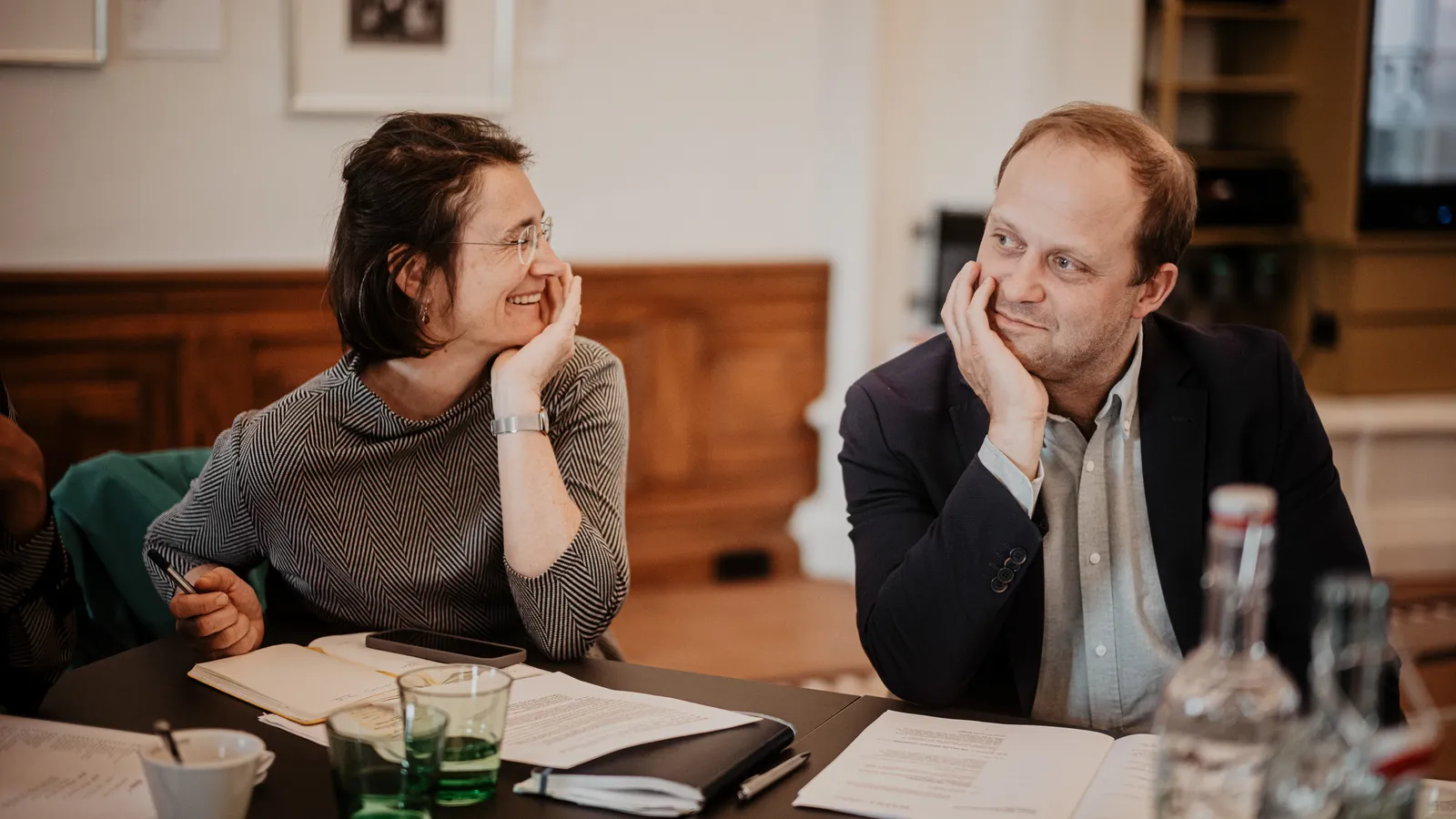
 Marek Rydzewski (right) at the Sciana Network residential meeting in May 2025. Photo Credit: Richard Schabetsberger
Leading with authenticity, trust, and endurance
21 Apr 2026
by Oscar Tollast
Sciana Fellow Marek Rydzewski reflects on his leadership development and Sciana experience
Marek Rydzewski is Deputy Chairman of the Board at AOK Nordost. Die Gesundheitskasse, the largest regional health insurance in Berlin, Brandenburg and Mecklenburg-Vorpommern. Various management positions allowed him to acquire a high level of expertise in digitalization, customer service, sales, insurance and integrated healthcare services. From 2021 to 2025, he served as Chief Digital Officer at BARMER, where he was responsible for the digital strategy and transformation of Germany’s second-largest health insurance.
He is committed to matters of Corporate Digital Responsibility (CDR) in healthcare. Additionally, he has been engaged in the German-Polish cooperation for cross-border healthcare since 2003. He studied culture and economics at the European University Viadrina in Frankfurt (Oder), Germany, and Aston University Birmingham, Great Britain. He is a member of Sciana’s sixth cohort.
This interview has been edited for brevity and clarity.
Sciana Network: What does leadership mean to you and do you think you've changed as a leader through your involvement with the Sciana Network?
Marek Rydzewski: Leadership is a huge responsibility. Not everybody is a leader and not everybody wants to be a leader. I think we need people who are convinced that this is the right role for them and who want to engage in this position. I see it as a privilege to be in charge of creating solutions and making decisions that influence other people.
I think leadership is a question of trust. My personal development, linked to Sciana but not only driven by Sciana, has improved my leadership. I learned a lot and I gained a "mirror" that allowed me to see where I stand in comparison to other people and gave me the possibility to reflect. You have to adapt information to your own situation, and be critical with yourself, but you have to stay true to yourself as well. You don't have to change everything just because you attended such a programme. You should be flexible, but you shouldn't break yourself just to change everything, because then you are not authentic.
I think authenticity is one of the most important qualities in leadership. People want to see role models who are authentic. One of my biggest learnings is that I have to listen more. I understand now that to find the right solution, you have to pay attention to other people, but at the same time, you have to give guidance. You have to build a bridge between expectations and reality as a leader.
SN: Outside of your day-to-day work, cycling is something that's very important to you. How would you reflect on the role it plays in your life?
MR: For me, cycling is synonymous with teamwork, even if we probably think about cycling as an individual sport. It's actually a team sport. At the competitive level, you see leaders, helpers, and supporters in the bunch. It's important to protect each other, especially in difficult conditions like crosswinds.
This connects to work. You will not always have tailwinds - you also have crosswinds or headwinds, where you must find the right formation to survive such difficult situations. In cycling, you start with short distances, and gradually extend them, which helps build endurance. For digital transformation, or any transformation process, endurance is more important than the ability to win a sprint.
I try to bring people to their limits in this way, extending distances step by step. Some people cannot imagine riding 200 or 300 kilometres, but when you train them and use the right tactics, they reach the point where they can follow you…I think there are a lot of similarities to management rules and teamwork, where different strengths have to be used at the right moment to succeed as a team.
Cycling also gives me a good opportunity to free my mind…and change perspectives. I think one of the most important things for leaders is the ability to change their perspective. When you go the same way by car or by bike, you notice different things because the speed is different and you are focused on different things… Cycling is important to me because it changes my perspective.
SN: Thinking about your challenge group, what attracted you to that particular group and what are your reflections on that experience?
MR: Prevention. Everybody knows that it is easier to prevent sickness or maintain health than treating disease. It is not only a question of economic aspects or providing healthcare, but also of quality of life and other things connected to this. Family health is also impacted by sickness. If you invest in prevention, you can enjoy your life more, which also has other implications.
At the end of the day, prevention is not recognised in the same way as other parts of the healthcare system. Everybody agrees it is important, but it remains a niche. I found the idea of being an activist quite interesting - advocating for prevention, but not necessarily in the old-fashioned way, rather in a new way.
Our challenge group developed an idea of how to engage with other leaders by sharing leadership skills or skills generally. We also put the recipients at the middle and built the product around their needs by asking them what they need and how they would like to get information... User-centric design is, from my perspective and experience, one of the best ways to get an effective solution, because this not only solves problems theoretically but also addresses the needs of recipients more effectively than a top-down approach.
SN: This is your final Sciana Network residential meeting. How would you reflect on your Sciana experience?
MR: The Sciana experience has been very important to me because I met a lot of very interesting people with different perspectives. I think the future of healthcare lies in recognising different perspectives and taking them into account if we want to drive the system forward. If we want to improve or sustain access to healthcare, we must recognise different developments - new technologies, shortage of workforce, cultural change, inclusion, and barriers which cannot be overcome just by acknowledging them but really finding a solution. In this context, it was also very important to reflect on my personal development…
SN: What is the one word you would use to describe your Sciana experience?
MR: Trust. In uncertain times, trust is really important. I found it valuable that we could share all our emotions, experiences, and different opinions and trust that this would stay within the group... We trusted that we could find common ground, build solutions together, and drive our product, project, or company in the right direction. Trust is very important in these difficult times.
Meet the Partners
Sciana — The Health Leaders Network is a joint initiative of The Health Foundation, Careum and the Bosch Health Campus, in partnership with Salzburg Global.