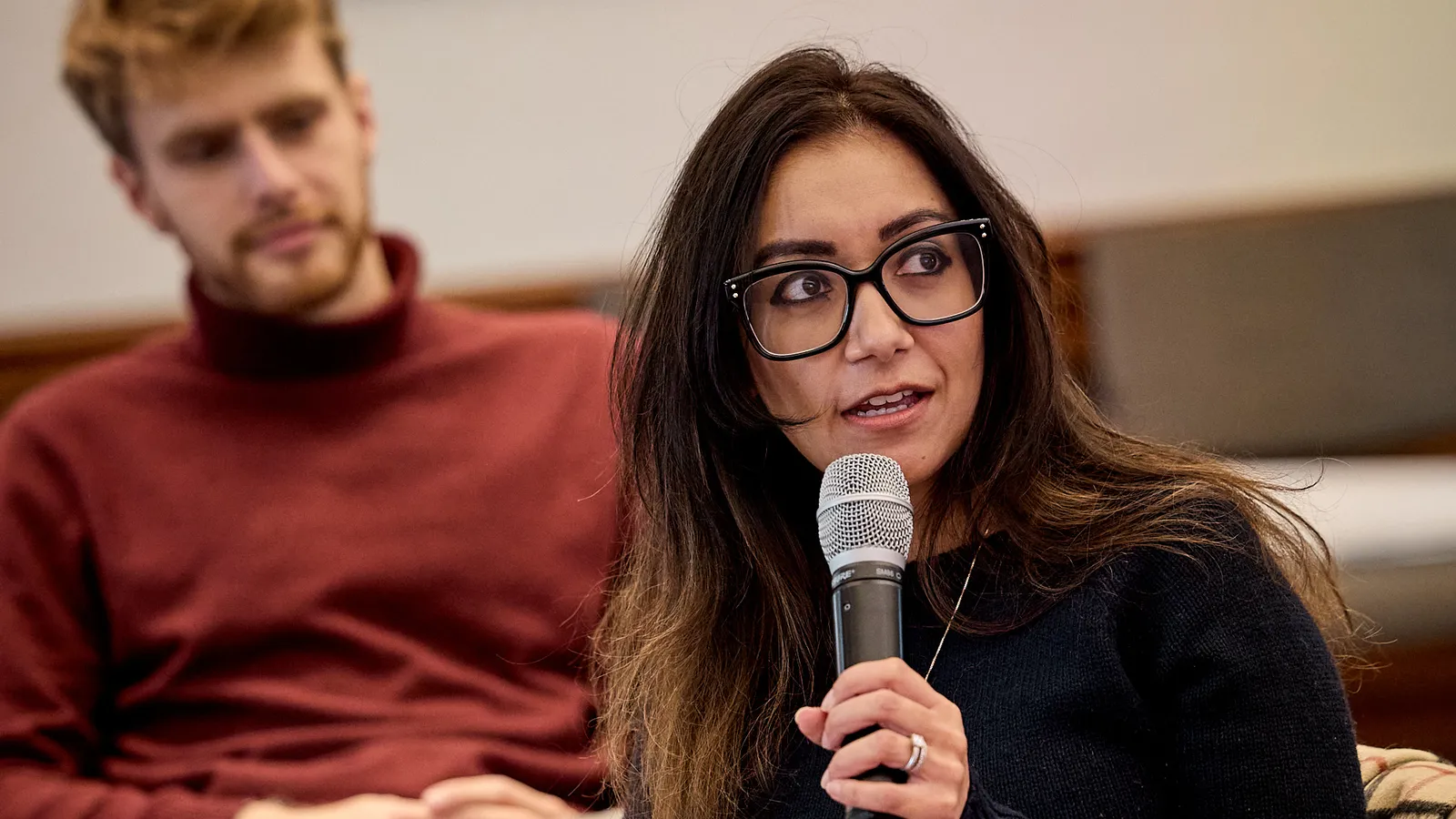
 Minal Bakhai at the Sciana Network residential meeting in November 2025. Photo Credit: Richard Schabetsberger
Rebuilding trust as a foundation for population health
11 May 2026
by Sneha Mahapatra and Audrey Plimpton
Sciana Fellow Minal Bakhai on why systems leadership for population health must develop “new ways of working, new relationships, and new partnerships to create something new”
Minal Bakhai is the National Director for Primary Care and Community Transformation and Improvement for the NHS in England and the SRO for the National Neighbourhood Health Implementation Programme. She leads national policy, strategy and delivery of large-scale-complex-change and digital transformation, including one of the largest systematic national improvement programs for primary care, transforming the model of general practice and accelerating ambitions for population health and integrated primary care. Prior to this she led national policy and delivery of digital first primary care. Minal's experience stretches across clinical practice, national leadership, innovation, research and regulation. This includes executive roles as Medical Director and Director of Research and Digital Innovation for McKesson UK scaling one of the UK's first digital health services; the development of the first UK standards for digital health services; and the appraisal of cost and clinical effectiveness of health technologies at NICE. She is also a practicing GP for 13 years in an area of extreme socio-economic deprivation. She is a member of Sciana’s seventh cohort.
This interview has been edited for brevity and clarity.
SN: What inspired you to apply for the Sciana Network, and how would you describe the experience so far?
MB: I think the quote from Margaret Mead really epitomizes why I wanted to join the Sciana Network: “Never doubt that a small group of thoughtful, committed citizens can change the world. Indeed, it's the only thing that ever has.”
The complex challenges we are facing regarding population health cannot be solved by any single person, institution, or country. The Sciana Network has created the space for purpose-driven, value-oriented leaders to come together to engage in conversation, share ideas and learning, and accelerate progress on this journey together. It creates a safe and reflective space for open, honest conversation, where we can step outside of our day-to-day lives, take off our institutional lanyards, dissolve old assumptions or things that got in the way, and reimagine new ways of leading while strengthening our leadership toolkit collectively. For me, it creates a mindset shift around the importance of prioritising our own personal and professional development to help us be better leaders… It has created the opportunity to go slow, in order to go fast. Through the power of conversation, collaboration, and the collective intelligence of the group, it has created a valuable space for co-producing new solutions to some of our most complex challenges.
SN: What are some of the traits that you look for in a leader, and is this something you’re mindful of in your own day-to-day work?
MB: Some of the key traits I look for in a leader are somebody who is kind and compassionate; who enables others, is permissive, creates agency, and can see beyond organisational boundaries to understand the whole system - including histories, incentives, and power dynamics. Somebody who can listen deeply and with humility, not to respond but to understand, and particularly understand the lived and learnt experiences of communities and the workforce – alongside the data.
A leader is somebody who has the courage to do things differently and to create the space to do things differently. For me, that is about lifting others - somebody that can set aside lanyards, hierarchies, and identities, and enable the diversity of voice in the room to thrive, co-create, co-produce, and co-learn together.
This is fundamental, because the complex challenges we are facing will only be solved through leveraging our greatest asset: the collective wisdom of our workforce, communities, organisations, and networks. The importance of bold, purposeful, values-oriented and community driven leadership has never been greater. We're going to have to use different leadership styles to get there - but if we are clear about our shared mission and values, we are more likely to be successful.
SN: You are part of the “Systems leadership for population health in times of scarcity” working group. What attracted you to this topic and what are you looking to learn?
MB: The key word for me is “scarcity.” This is something I experience almost every day in my role in the NHS - scarcity of time, funding, resources, workforce, and, fundamentally, scarcity of trust. One of the biggest challenges we face as a society is increasing mistrust between some of our most vulnerable communities and the state.
If we want to improve population health, we must reset that relationship and rebuild trust. For me, this is about developing new ways of thinking, new ways of working, and new ways of delivering care - and then hardwiring those changes into the wider environment we work in. We should create enabling conditions to embed and to sustain these changes, through funding flows, regulation, performance frameworks, and outcomes.
We have traditionally worked in a bureaucratic system that, in times of scarcity, can challenge our ability to make improvements in population health because of more barriers - more forms, more referral criteria, more thresholds to access care, more fragmentation - when what we need is more relational, human care. There's a huge amount of evidence that if we build more continuity and relational care into our systems, we not only improve people's health outcomes and reduce premature mortality, we also reduce demand pressures on the system and improve people's experience.
For me, a lot of this is about how we look at health beyond the lens of healthcare - how we shift from a system focused on body parts to looking at whole-person care, whole households, and how people connect to their communities and places they live. We know that wider social determinants of health drive 80% of health outcomes, and that 99.9% of care happens at home.
We need to move away from a culture that asks, "what's the matter with you?" to "what matters to you?" - doing with rather than doing to. That is fundamentally a shift in power from institutional power to community power, enabling us to see what the traditional system could not see. That means that we can be much more strengths-based, flexible, and deeply attuned to people's lives and therefore what matters to them. That fundamentally drives more value-orientated health and care.
By giving people permission to remove the barriers that get in the way of being able to do the best for the people we're caring for and integrating the way we work across multi-agency teams, it helps us be more agile and develop a system that's able to respond to what we're seeing.
Once what we're seeing and how we respond fit better, then not only are we improving the quality-of-care delivery, we are making higher quality decisions. This will start to drive better population health outcomes.
The Sciana Network gives us the space to explore how different countries are tackling this challenge so that we can learn from each other, generate new ideas together, and collectively progress this ambition.
SN: Why has your group chosen public-private partnerships as the focus of your Sciana Cohort 7 challenge?
MB: We believe there is an opportunity to expand the partnership approach, as no single organisation can do this alone. We are expanding our partnerships to look at: What does a public-private partnership (PPP) look like?
Some key questions that we're asking ourselves are: Can we identify any PPPs that have helped drive transformation, enabled by digital and data, and understand what worked? What are the specific challenges these PPPs have helped to solve? Where we identify these, how do we make a PPP easier to implement? What does a good partnership look like? How do we collectively make the best of all the capabilities we have? How do PPPs look different in a digital age?
Our aim is that PPPs on their own are not a means to an end. Our hypothesis is that they can help drive better outcomes, both in terms of how we allocate our resources and move to a more value-oriented approach, and how we can support co-management and activate individuals, families, carers, and support them in co-managing their health, wellbeing, and long-term conditions. How, through better and more informed resource allocation, supporting high quality personalised decision making, but also better design of digital technology, can we start to reduce health inequity? How could PPPs help us increase investment in social infrastructure?
As we focus on the changes needed to drive population health in times of scarcity, partnerships need to invest not only in solutions but also in reshaping the conditions around them, so that new models can survive and grow. We need to create safe spaces where we can stop things that are not working - dissolve bureaucracies and power imbalances, reshape ways of working, invest in building trusted relationships, and develop durable partnerships – building the capability to devolve budgets and decision making closer to where people live – preventing crisis and creating health.
What will ultimately determine success is not just how we design services - it is whether we invest in the social infrastructure that holds communities together. The relationships, networks, and local organisations that people trust and rely on are the foundation of prevention and health creation. We need the wider environment to enable those changes to survive and grow and be deeply rooted.
Minal has kindly provided additional resources, and we invite you to explore these further:
- Unleashing The Power Of Communities | The King's Fund
- How To Put Community Partnership At The Heart Of Neighbourhood Health | The King's Fund
- Fostering co-production and tackling racism will build an NHS fit for all | HSJ Partners | Health Service Journal
- Neighbourhood Health Network | Groups | LinkedIn
- Neighbourhood Health - Home
Meet the Partners
Sciana — The Health Leaders Network is a joint initiative of The Health Foundation, Careum and the Bosch Health Campus, in partnership with Salzburg Global.