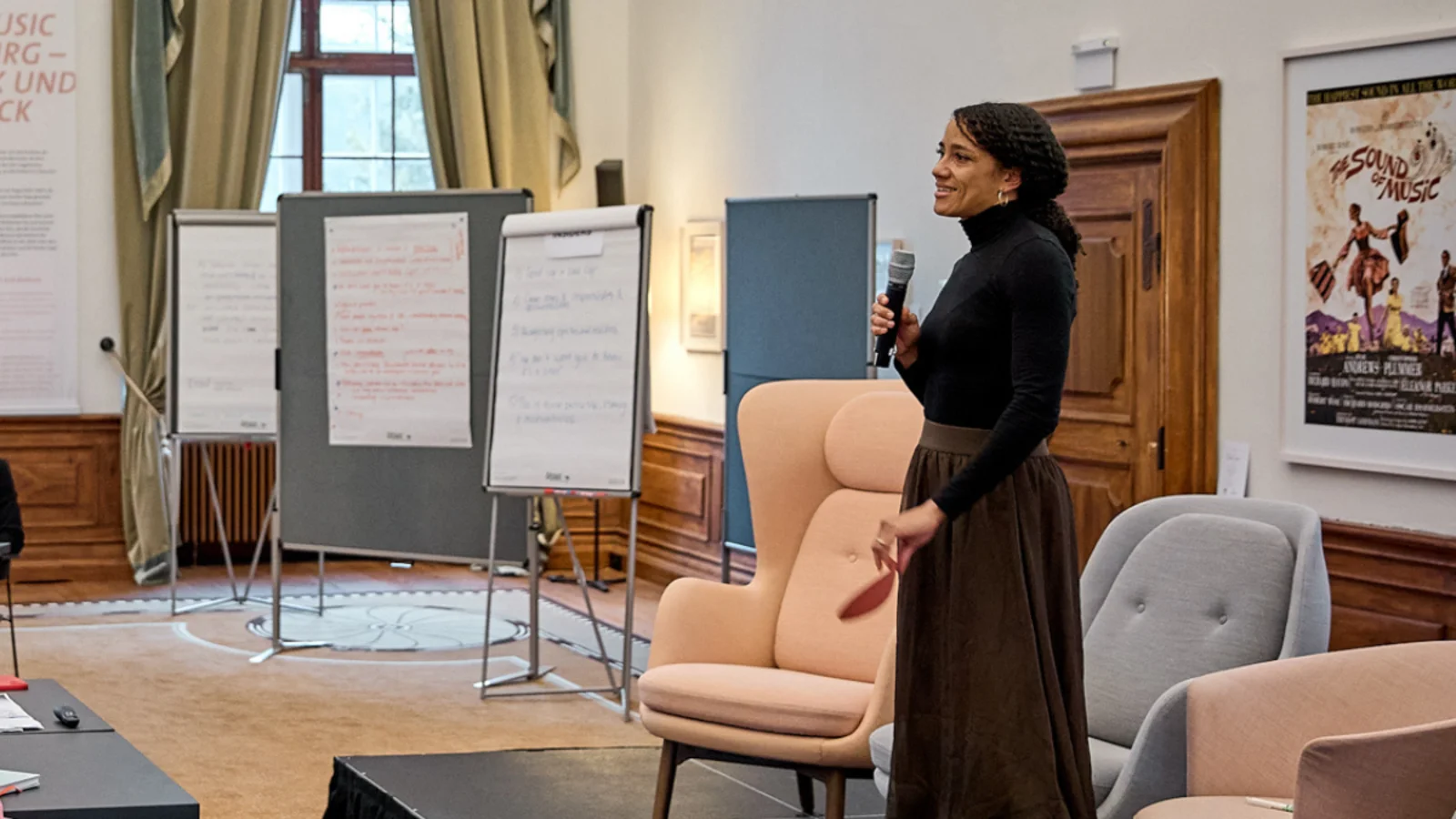
 Mirjam Lämmle at a Sciana Network residential meeting in November 2025
Fellows in Focus: November and December 2025
23 Dec 2025
by Sciana Network
Updates concerning Sciana Fellows in November and December 2025
Reflections on dying, death, and end-of-life care
Mirjam Lämmle (Cohort 6) has authored an article reflecting on end-of-life care, a subject she studied as part of the cohort's Sciana Challenge.
In this piece for palliative.ch, Mirjam discusses what she learned from the experience and how she'll apply these lessons in life and work. Read her LinkedIn post to learn more and help amplify the group's findings.
Building accessible pathways and rethinking mental health systems
Kai Lanz (Cohort 7) shares his journey of building mental health services, what systems leadership means in times of crisis, and why early intervention is key to sustainable change.
Celebrating the founding of the PPIE Network
Judith Safford (Cohort 3) shared her thoughts on the founding of the PPIE Network, a non-profit association committed to promoting patient and public involvement and engagement (PPIE) in Switzerland.
Judith said, "Switzerland, with its healthcare organizations, research institutions, regulators, and policymakers, has lagged behind other European countries in patient involvement. I believe this bottom-up, patient-led initiative could give Switzerland the opportunity to become a leader in [important] areas of civil engagement, such as citizen science.
"Worried by the slow progress in health reform, I am excited about the creation of an organization committed to working across care, research, education, and with all those affected by health conditions—regardless of diagnosis."
New position for Marek Rydzewski
Marek Rydzewski (Cohort 6) has returned to AOK Nordost, having been appointed deputy chairman of the executive board. He began his new role on 1 November. Read Marek's announcement on LinkedIn and the press announcement.
Saskia De Gani attends launch of Rome Coalition on Health Literacy and Human Rights
Saskia De Gani (Cohort 5) participated in the recent launch of the Rome Coalition on Health Literacy and Human Rights.
Sharing brief thoughts on LinkedIn, Saskia discussed how health literacy can offer "a promising, powerful and actionable pathway forward" to strengthen the protection of health as a human right and secure population health.
Maxine Mackintosh co-hosts BMJ Future Health podcast
Maxine Mackintosh (Cohort 6) is the co-host of the new BMJ Future Health podcast.
The show, which Maxine co-hosts with Cat Bruce, explores the "bleeding edge" of health innovation, from life sciences research to navigating health misinformation on platforms like TikTok.
Watch a trailer, listen to the first episode with Bilal Mateen, and subscribe.
Tobias Silberzahn to chair Movement Health Foundation's EMEA Board
Tobias Silberzahn (Cohort 3) has become chair of the Movement Health Foundation's EMEA Board. The Foundation's a global initiative launched in 2023 to bring life-saving health innovations to people in low- and middle-income countries.
Meanwhile, Tobias has continued to publish articles as part of "The people behind healthcare innovation" series. Recent interviews include: Dan Nardi, CEO of Reimagine Care; Ram Khandelwal, founder of Heart Health India Foundation; and Thomas Duprée, CEO of KLASSE2000.
EHU Podcast: New horizons for the European Health Union
Dorli Kahr-Gottlieb (Cohort 3) spoke with former Sciana Lecture speaker Vytenis Andriukaitis on how far the European Health Union has come and where the next phase must focus. This podcast is available to listen to on Spotify and Apple.
Leading with Dignity in Ambiguity: Bogi Eliasen on Frameworks, Spiral Dynamics, and Cultural Spirals
Honorary Fellow Bogi Eliasen, who is executive director of the Movement Health Foundation, has reflected on how principles and patterns can guide leadership when certainty is out of reach.
Bogi's thoughts were included in a LinkedIn article published by From Why to We: Transformational Leadership.
Tobias Gantner authors chapter for Medical Device Management book
Tobias Gantner (Cohort 1) has contributed a chapter for a new book titled "Medical Device Management - A Comprehensive Guide to Markets, Marketing, and Regulations".
His chapter is titled "Technology Needs Attitude: Leading Health Innovation Through Human Competence". Read Tobias' post on LinkedIn and access the article online for free.
Helen Crimlisk joins NHS delegation to Medica Innovation Forum
Helen Crimlisk (Cohort 5) recently joined a senior NHS delegation to the Medica Innovation Forum in Düsseldorf. It was a chance to explore the potential for collaboration with global partners in life sciences and innovation.
During the conference, Helen spoke on a panel titled "Together We Thrive: Closing the Gender Gap in Healthcare." She also participated in a roundtable discussion exploring the broader issues surrounding diversity, health and healthcare and the important intersectionalities between women’s health and ethnicity, poverty, caring, education and gender identity.
Helen's take-home message from the Forum is that "the world is changing rapidly as a result of demographic, economic, climate, and workforce shifts. Change needs to be radical and involve rethinking pathways for health and healthcare with a focus on prevention, poly-morbidity, community, and digitalisation.
"It is critical that these things are done in tandem and that we don’t lose the opportunity for radical change by ‘baking in’ current inequities and digitally replicate over-complex pathways by applying digital solutions without system redesign.
"To achieve this, we need to work with communities and patients to retain trust and enable good ideas to become more than pilots, translating into impactful change using improvement methodology and implementation science.
With any change, there is a risk of worsening inequalities, either because of digital or geographical exclusion, because of issues around trust and poverty, or because people with additional complexity, disability, or protected characteristics are further marginalised.
“Innovation needs to be designed with inclusion in the forefront of our minds. If an innovation works for disadvantaged or excluded groups, it will work for all, and the impact of innovation will be greater and sustainable.”
A call for a shared future vision for Planetary and One Health Literacy
A Sciana Fellow, a Sciana International Advisor, and two former Sciana guest speakers have co-authored a new article arguing for a unified understanding of planetary health literacy and One Health literacy.
Saskia De Gani (Cohort 5), Ilona Kickbusch, Gerardine Doyle, and Simon Ruegg have collaborated on the publication with Carmen Jochem and Kristine Sørensen.
They call for a shared conceptual vision, a coherent research agenda, and collaborative action across disciplines and sectors.
Meet the Partners
Sciana — The Health Leaders Network is a joint initiative of The Health Foundation, Careum and the Bosch Health Campus, in partnership with Salzburg Global.